Architectural Rendering Plans: A Comprehensive Guide to Creating Stunning Visualizations
#Architectural Rendering Plans: A Comprehensive Guide to Creating Stunning Visualizations
Creating effective architectural rendering plans is essential for transforming your design concepts into compelling visual presentations. Whether you’re working on residential projects, commercial developments, or large-scale architectural endeavors, a well-structured rendering plan ensures that your visualizations effectively communicate your design intent and captivate your audience.

#Understanding Architectural Rendering Plans
Architectural rendering plans are strategic blueprints that outline how you’ll visualize and present your architectural designs. These plans go beyond simply creating images—they encompass the entire process from initial concept through final presentation, ensuring that every visualization serves a specific purpose and contributes to your overall communication strategy.
A comprehensive architectural rendering plan addresses key questions: What views are most important? What level of detail is required? What style best represents the project? How will the visualizations be used? Answering these questions upfront saves time, reduces costs, and produces more effective results.
#Key Components of Architectural Rendering Plans
#Project Analysis and Objectives
Before creating any visualizations, your architectural rendering plans must begin with a thorough analysis of the project and clear objectives:
- Project Type: Residential, commercial, institutional, or industrial projects each require different rendering approaches
- Target Audience: Clients, investors, planning authorities, or marketing teams have different needs and expectations
- Project Timeline: Understanding deadlines helps prioritize which visualizations are most critical
- Budget Constraints: Realistic budgets inform the scope and quality of rendering work
- Communication Goals: What story are you trying to tell with your visualizations?
#View Selection Strategy
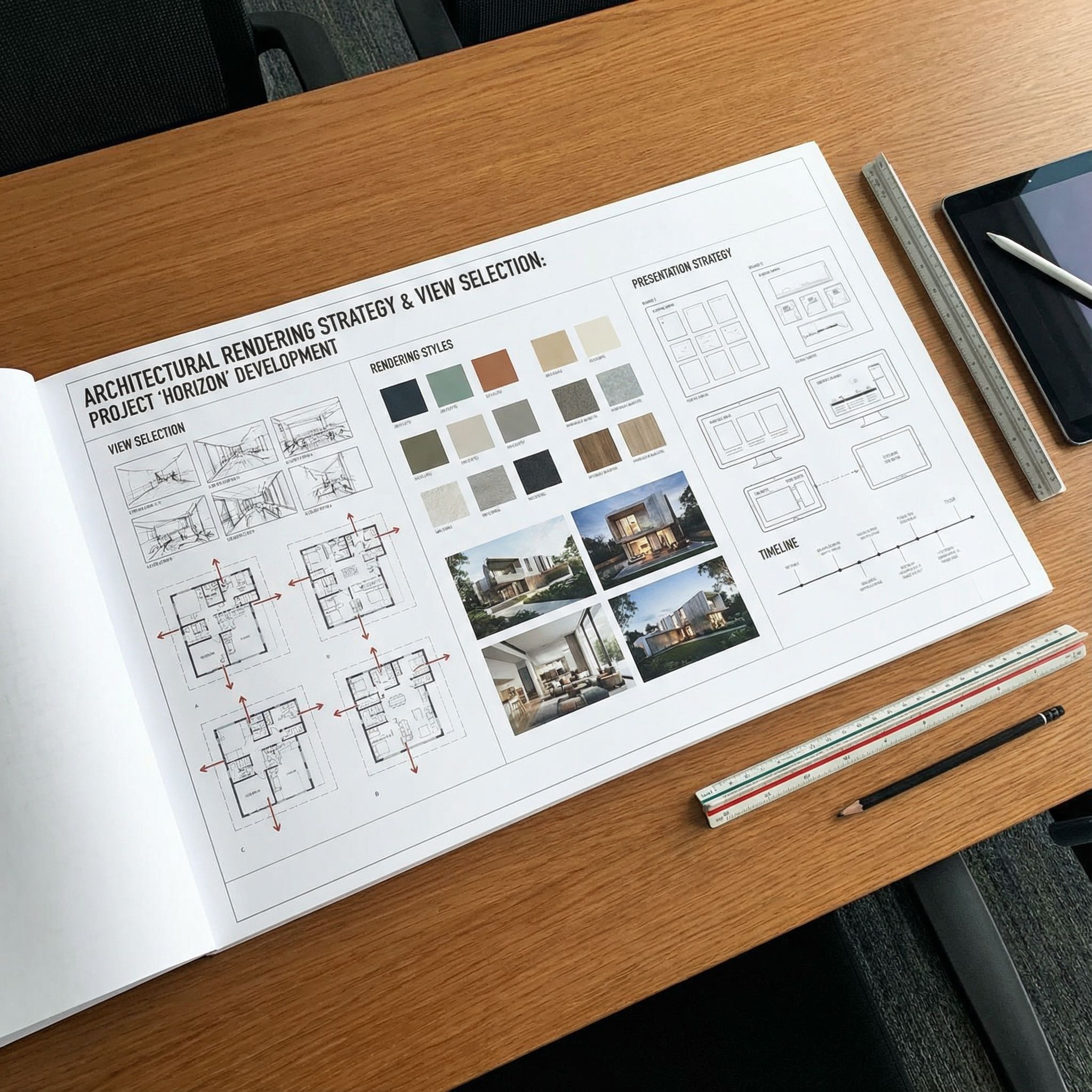
One of the most critical aspects of architectural rendering plans is determining which views to create. Strategic view selection ensures you capture the most important aspects of your design:
- Exterior Views: Street-level perspectives, aerial views, and contextual shots showing the building in its environment
- Interior Views: Key spaces that demonstrate functionality, atmosphere, and spatial relationships
- Detail Views: Close-ups of important architectural elements, materials, or design features
- Process Views: Before-and-after comparisons, construction sequences, or design evolution
- Contextual Views: How the building relates to its surroundings, neighborhood, or landscape
Effective architectural rendering plans balance comprehensive coverage with focused storytelling, ensuring each view adds unique value to the presentation.
#Rendering Style and Quality Decisions
Your architectural rendering plans should specify the rendering style and quality level for each visualization:
Photorealistic Rendering: Best for final presentations, marketing materials, and client approvals. Requires significant time and resources but produces the most convincing results.
Realistic but Stylized: Balances realism with artistic expression, often faster to produce while maintaining professional quality.
Conceptual Rendering: Quick, expressive visualizations ideal for early design phases and exploring ideas.
Technical Rendering: Focused on accuracy and clarity, emphasizing dimensions, materials, and construction details.
Hybrid Approaches: Combining multiple styles within a single project to serve different purposes and audiences.
#Material and Lighting Strategy
Architectural rendering plans must address material representation and lighting conditions:
- Material Selection: Which materials are most important to showcase? How will they be represented?
- Lighting Scenarios: Day, night, golden hour, or specific times of day that best represent the design
- Seasonal Considerations: How different seasons affect the building’s appearance and context
- Atmospheric Conditions: Clear skies, overcast, or dramatic weather that enhances the narrative
#Creating Your Architectural Rendering Plan
#Step 1: Define Your Goals
Start your architectural rendering plans by clearly defining what you want to achieve:
- Primary Goals: What is the main purpose of these visualizations?
- Secondary Goals: What additional benefits can the renderings provide?
- Success Metrics: How will you measure if the rendering plan is effective?
#Step 2: Inventory Your Assets
Before creating new visualizations, assess what you already have:
- Existing Drawings: Floor plans, elevations, sections, and details
- 3D Models: Current model status and what needs to be developed
- Reference Materials: Photos, material samples, and inspiration images
- Previous Renderings: What worked well in past projects?
#Step 3: Determine View Requirements
Based on your goals, create a prioritized list of required views:
- Must-Have Views: Essential for project success
- Should-Have Views: Important but not critical
- Nice-to-Have Views: Enhance presentation but can be omitted if needed
This prioritization helps manage time and budget effectively.
#Step 4: Select Rendering Methods
Choose the appropriate rendering methods for each view in your architectural rendering plans:
- Traditional 3D Rendering: For high-quality, photorealistic results
- AI-Powered Rendering: For rapid iteration and sketch-to-render workflows
- Real-Time Visualization: For interactive presentations and VR experiences
- Hybrid Approaches: Combining methods for optimal results
#Step 5: Establish Timeline and Milestones
Your architectural rendering plans should include a realistic timeline:
- Phase 1: Model preparation and initial setup
- Phase 2: Material and lighting setup
- Phase 3: Rendering execution
- Phase 4: Post-processing and refinement
- Phase 5: Final delivery and presentation
Build in buffer time for revisions and unexpected challenges.
#Step 6: Allocate Resources
Determine what resources you’ll need:
- Software: 3D modeling, rendering, and post-processing tools
- Hardware: Computing power for rendering, storage for large files
- Personnel: Who will handle modeling, rendering, and post-processing?
- Budget: Costs for software licenses, cloud rendering, or outsourcing
#Best Practices for Architectural Rendering Plans
#Start Early
The most effective architectural rendering plans are created early in the design process. Early planning allows you to:
- Identify visualization needs before design is finalized
- Build models with rendering in mind
- Avoid costly rework and revisions
- Integrate rendering workflow with design development
#Maintain Consistency
Consistency across all visualizations strengthens your presentation:
- Visual Style: Use consistent rendering styles, color palettes, and lighting
- Quality Level: Maintain similar quality across all views
- Presentation Format: Consistent framing, composition, and post-processing
- Naming Conventions: Organized file naming for easy management
#Iterate and Refine
Architectural rendering plans should be living documents that evolve:
- Regular Reviews: Check progress against the plan regularly
- Flexibility: Adjust plans based on new requirements or discoveries
- Feedback Integration: Incorporate client and team feedback
- Continuous Improvement: Learn from each project to improve future plans
#Consider Multiple Use Cases
Effective architectural rendering plans anticipate various uses for the visualizations:
- Client Presentations: High-quality, polished images
- Marketing Materials: Striking visuals optimized for print and digital
- Planning Submissions: Accurate representations for authorities
- Construction Documentation: Technical views for builders
- Portfolio Development: Showcase work for future projects
#Common Challenges in Architectural Rendering Plans
#Scope Creep
One of the biggest challenges is managing scope. To prevent scope creep in your architectural rendering plans:
- Clear Boundaries: Define exactly what’s included and excluded
- Change Management: Establish a process for handling additional requests
- Prioritization: Always refer back to your prioritized view list
- Communication: Keep stakeholders informed about scope and timeline
#Time Management
Rendering can be time-consuming. Effective architectural rendering plans address this by:
- Realistic Estimates: Base timelines on experience, not optimism
- Parallel Processing: Render multiple views simultaneously when possible
- Efficient Workflows: Use templates, presets, and automation
- AI Acceleration: Leverage AI tools to speed up certain processes
#Quality vs. Speed Trade-offs
Balancing quality and speed is crucial. Your architectural rendering plans should:
- Tier Quality Levels: Define different quality levels for different purposes
- Strategic Investment: Invest time in key views, use faster methods for others
- Technology Selection: Choose tools that match your quality and speed requirements
- Hybrid Approaches: Combine quick previews with detailed final renders
#Technical Complexity
Managing technical complexity requires:
- Skill Assessment: Honestly evaluate your team’s capabilities
- Training: Invest in learning new tools and techniques
- Tool Selection: Choose software that matches your skill level
- Support Resources: Have access to tutorials, forums, or consultants
#Modern Tools for Architectural Rendering Plans
#AI-Powered Rendering
Modern AI tools have revolutionized architectural rendering plans by enabling:
- Rapid Iteration: Generate multiple variations quickly
- Sketch-to-Render: Transform hand drawings into photorealistic images
- Style Transfer: Apply different architectural styles to the same design
- Accessibility: Professional results without extensive technical expertise
Platforms like Evermake integrate AI-powered rendering into your architectural rendering plans, making high-quality visualization accessible and efficient.
#Cloud Rendering Services
Cloud rendering services support your architectural rendering plans by:
- Scalability: Access powerful hardware without upfront investment
- Parallel Processing: Render multiple views simultaneously
- Cost Efficiency: Pay only for what you use
- Accessibility: Work from anywhere with internet access
#Real-Time Visualization Engines
Game engines and real-time visualization tools enhance architectural rendering plans with:
- Immediate Feedback: See changes instantly
- Interactive Presentations: Clients can explore designs themselves
- Virtual Reality: Immersive experiences for stakeholders
- Live Collaboration: Multiple people can view and discuss simultaneously
#Integrating AI into Your Architectural Rendering Plans
#When to Use AI Rendering
AI-powered rendering fits into architectural rendering plans when you need:
- Quick Concept Visualization: Rapid exploration of design ideas
- Sketch Refinement: Transforming rough sketches into polished renders
- Multiple Variations: Exploring different design options quickly
- Budget Constraints: High-quality results with lower costs
- Tight Deadlines: Fast turnaround without compromising quality
#Combining AI and Traditional Methods
The most effective architectural rendering plans often combine AI and traditional rendering:
- AI for Early Stages: Use AI for quick iterations and concept development
- Traditional for Finals: Use traditional rendering for key presentation views
- Hybrid Workflows: Use AI to enhance traditional renders in post-processing
- Selective Application: Choose the best method for each specific view
#Presentation and Delivery in Architectural Rendering Plans
#Format Considerations
Your architectural rendering plans should specify delivery formats:
- Print Resolution: High-resolution images for physical presentations
- Digital Formats: Optimized files for web, email, and digital presentations
- Interactive Formats: Real-time viewers, VR experiences, or web-based presentations
- Animation: Video walkthroughs or flyovers for dynamic presentations
#Organization and Naming
Well-organized architectural rendering plans include:
- File Naming Conventions: Consistent, descriptive names for easy management
- Folder Structure: Logical organization by view type, phase, or purpose
- Version Control: Track revisions and iterations
- Metadata: Include project information, dates, and rendering settings
#Quality Control
Before final delivery, architectural rendering plans should include quality checks:
- Accuracy Review: Verify dimensions, materials, and details match the design
- Visual Quality: Check for artifacts, lighting issues, or rendering errors
- Consistency Check: Ensure all views maintain consistent style and quality
- Client Approval: Get sign-off on key visualizations before final production
#Conclusion
Effective architectural rendering plans are the foundation of successful visualization projects. By carefully planning your approach, selecting appropriate views and methods, and managing resources effectively, you can create compelling visualizations that communicate your design vision clearly and persuasively.
Whether you’re using traditional rendering methods, modern AI-powered tools, or a combination of both, a well-structured architectural rendering plan ensures that every visualization serves a purpose and contributes to your project’s success. The key is to start planning early, remain flexible, and continuously refine your approach based on experience and feedback.
As technology continues to evolve, new tools and methods will emerge, but the fundamental principles of good architectural rendering plans—clear objectives, strategic thinking, and effective execution—will remain constant. By mastering these principles, you’ll be equipped to create stunning visualizations for any architectural project.
Ready to streamline your architectural rendering plans with AI-powered tools? Try Evermake and discover how AI can accelerate your rendering workflow while maintaining professional quality.
Related Posts